
You see a price, you buy, and you end up with fewer tokens than the price promised. Nobody robbed you. That gap is called slippage, and it comes straight from how a liquidity pool sets its price. This guide follows Market Cap vs Liquidity and What Is a Rug Pull?, and explains why a buy fills at a worse price, how the size of the pool changes that, and what the slippage setting in your wallet is for.
For the full video explanation, check out this YouTube video:
The Pool We Are Using
A simple pool with two sides:
- $50,000 of ETH on one side
- 500 million tokens on the other
- Price on screen: $50,000 ÷ 500,000,000 = $0.0001 a token
How a Pool Sets Its Price
A pool is two piles, and the price is one pile divided by the other.
The pool follows one rule: multiply the two piles together, and that number has to stay the same after every trade. On Uniswap v2 and the many exchanges built like it, this is written x * y = k.
So when you add ETH to one pile, tokens have to come out of the other, exactly enough to keep that number the same. Every trade slides the pool along one curve. More ETH and fewer tokens means a higher price.
Why Your Own Buy Moves the Price
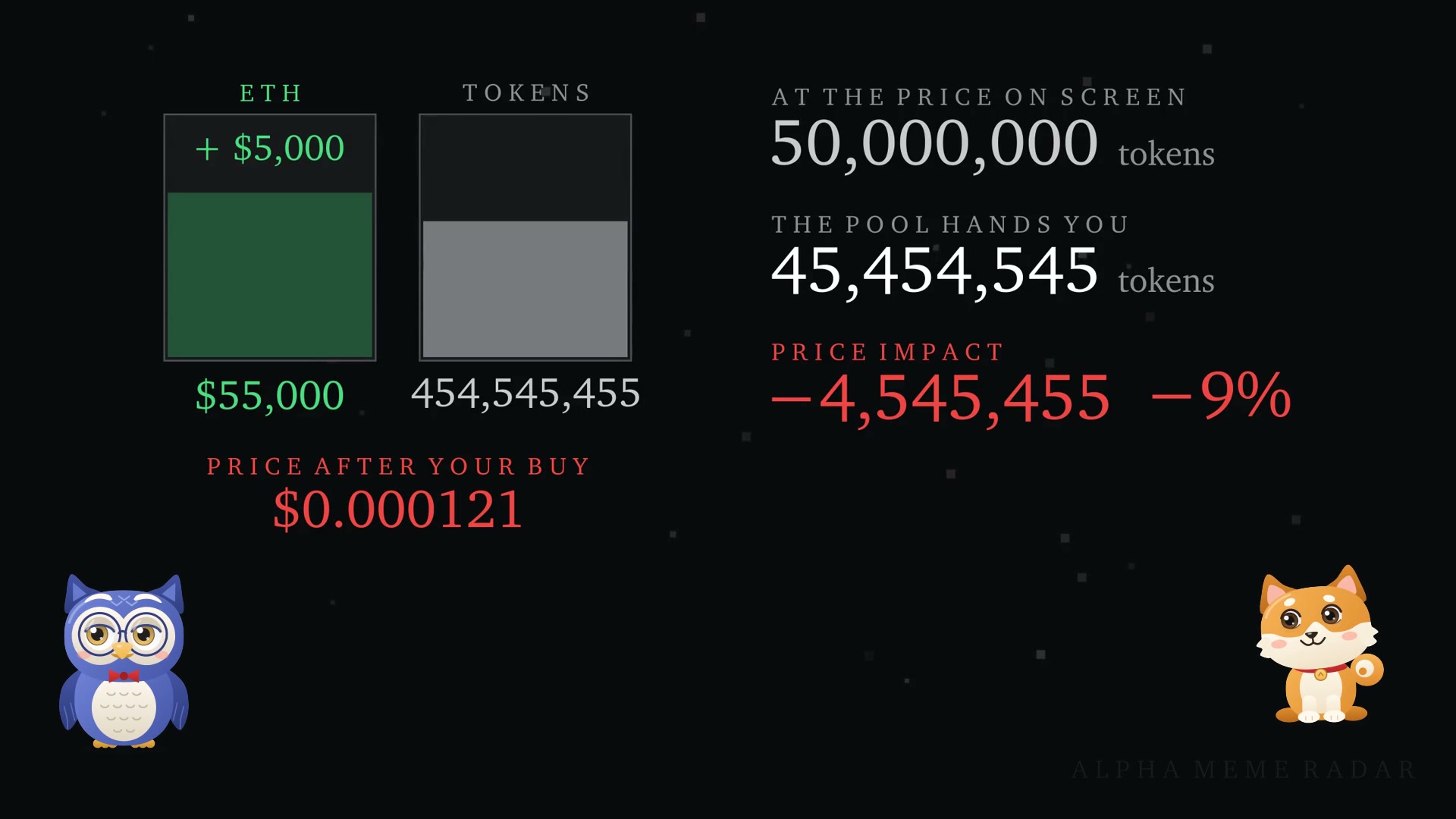
Say you buy with $5,000.
At the price on screen, $5,000 should get you 50 million tokens. But your ETH goes into the pile as part of the trade. The ETH side is now $55,000, so the rule only lets the pool hand you about 45.45 million tokens.
Tokens | |
|---|---|
At the price on screen | 50,000,000 |
What the pool hands you | 45,454,545 |
Missing | 4,545,455 (about 9%) |
This part of the gap is called price impact. Your own trade pushed the price up while it was filling, so each token cost a little more than the one before. You paid $0.00011 a token on average, and the pool's price after your buy is $0.000121.
The price on screen is only the price of the first token.
Pool Size Decides How Bad It Is
Price impact depends on how big your trade is next to the pool.
Pool | Your $5,000 buy comes up short |
|---|---|
$50,000 of ETH | about 9% |
$500,000 of ETH (ten times bigger) | about 1% |
Small trade, deep pool, small impact. This is one more reason to look at the liquidity number before you buy, not only the market cap.
What the Slippage Setting Does
Price impact is known before you trade: your wallet or the exchange can work it out and show it in the quote. The slippage setting is for what happens after the quote.
A quote is a snapshot. Before your trade lands, other people can trade in the same pool, and the price moves again. The slippage setting says how much worse than the quote you are willing to accept. Under the hood it becomes a minimum number of tokens. If the trade would give you less, it fails.
In our example the quote is 45,454,545 tokens:
- Set slippage to 1% and your minimum is 45,000,000 tokens.
- Someone buys $1,000 of the coin just ahead of you.
- Your $5,000 would now get about 43.77 million tokens. That is under your minimum, so the trade fails. You keep your ETH, though you still pay the network fee for the failed transaction.
Why Not Just Set It to 50%?
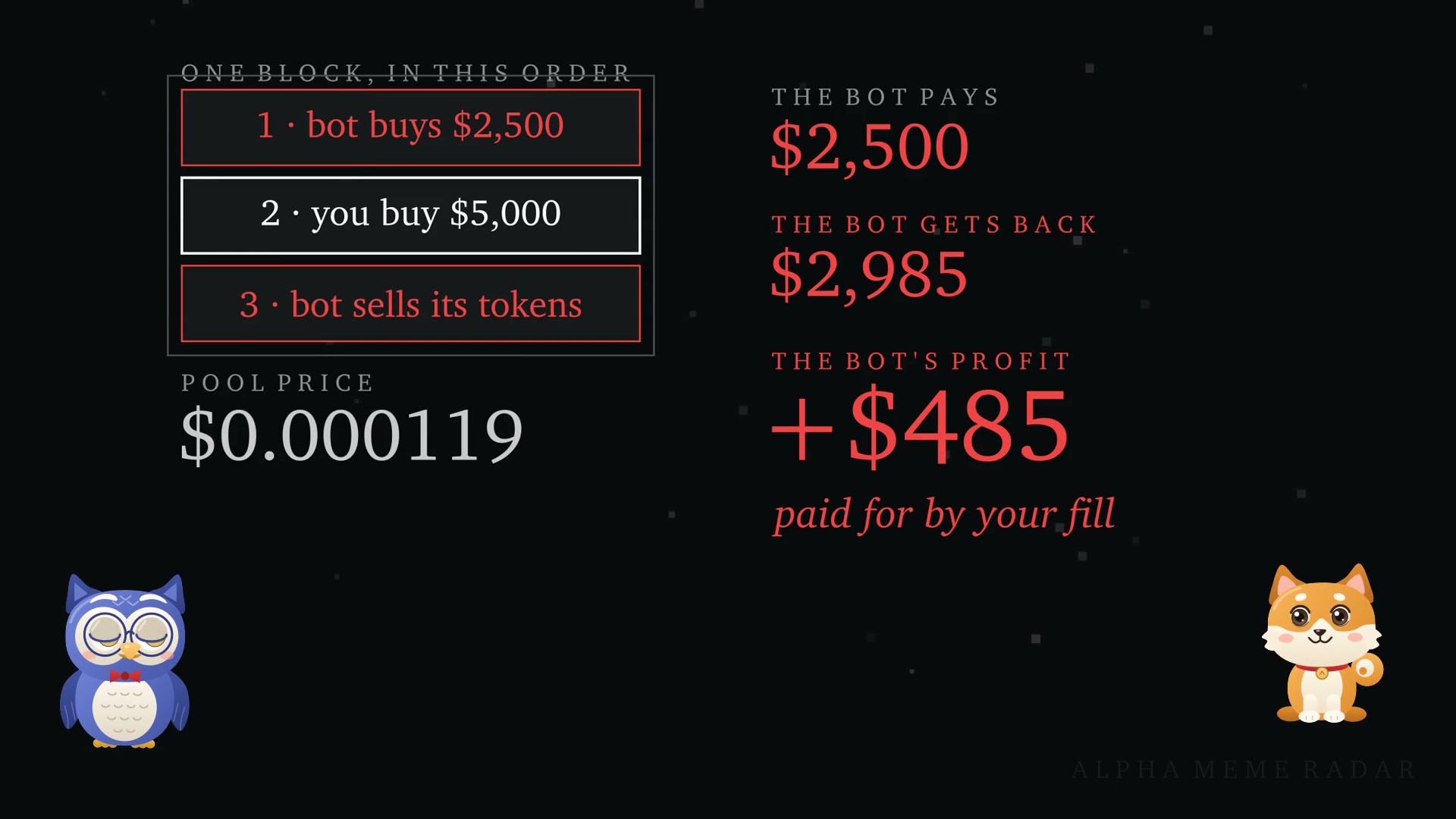
Because then a bot can move the price against you on purpose.
- The bot sees your trade waiting and buys right before you, pushing the price up.
- Your buy fills at the worse price. Your setting allows it.
- The bot sells right after, into the price your buy pushed up.
This is called a sandwich. With a 50% setting in our example, your minimum drops to about 22.7 million tokens. Everything between the quote and that minimum is room you have offered.
How to Use This Before You Buy
- Compare your trade to the pool. A buy that is 10% of the ETH in the pool will cost you about 9% in price impact. A buy that is 1% will cost about 1%.
- Split a large buy, or pick a deeper pool, if the price impact in the quote is more than you want to pay.
- Keep the slippage setting as tight as the trade allows. If trades keep failing, raise it a little at a time instead of jumping to a huge number.
What This Guide Does Not Cover
The numbers here ignore swap fees, which make every fill a little smaller. Some tokens also charge a tax on each buy or sell, and those need a wider slippage setting to trade at all. Pools with concentrated liquidity (Uniswap v3 and later) follow the same idea, but their depth depends on the price range. Some wallets offer private routes that hide your trade from sandwich bots; that is a separate topic.
The numbers are a worked example, not market data.
Key Takeaways
- Slippage is the gap between the price you saw and the price you got.
- A pool is two piles, and one rule keeps their product the same. Every buy moves the price.
- Price impact is the part your own trade causes. It grows with the size of your trade next to the pool.
- The slippage setting is a minimum: if you would get less, the trade fails.
- A wide setting gives sandwich bots room. Keep it tight.
Next: What Is a Sandwich Attack? How Bots Take a Cut of Your Memecoin Trade
This article is for education only and is not financial advice.