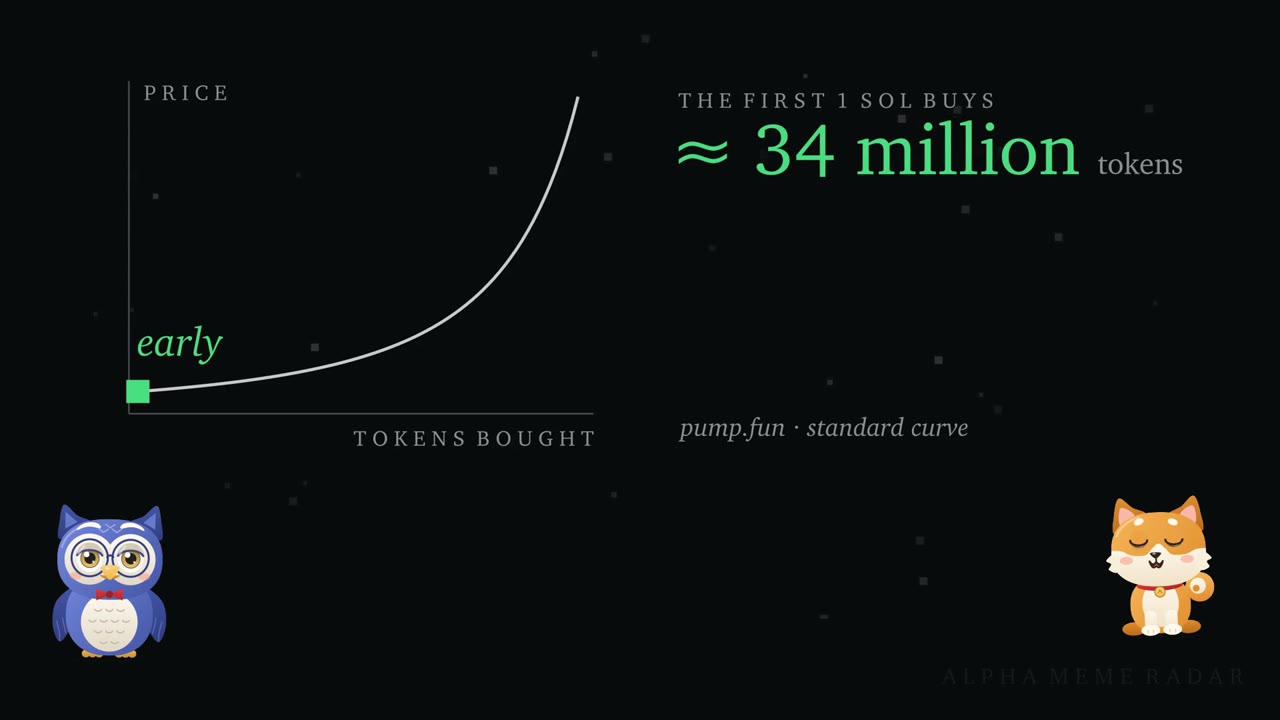
A bonding curve is a price list built into a launchpad. The more tokens people have bought, the higher the next price. That one rule decides who pays the least for a new memecoin, what "90% bonded" really tells you, and what happens when the buying stops. This guide follows Market Cap vs Liquidity and What Is a Rug Pull?.
For the full video explanation, check out this YouTube video:
A Price List, Not a Pool
A normal coin needs someone to fund a pool before anyone can trade. On a launchpad, nobody does. You buy straight from the curve, and you sell straight back to it.
Every buy moves the price up the curve. Every sell moves it back down.
Early Is Much Cheaper
The numbers below come from pump.fun's standard curve. Other launchpads use different numbers, but the shape is the same.
| When you buy | What 1 SOL buys |
|---|---|
| The very first SOL | about 34 million tokens |
| When the curve is 90% full | about 4 million tokens |
Same money, almost nine times fewer tokens.
Who Buys First
Often the creator. A coin can be created and bought in the same moment, before anyone else has seen it.
On the standard curve, 5 SOL at the very start buys about 15% of all the tokens. Those are the cheapest tokens the coin will ever have.
What Happens at 100%
When the curve is full, the coin graduates:
- About 800 million of the one billion tokens have been sold.
- About 85 SOL is sitting in the curve.
- On pump.fun's PumpSwap migration path, that SOL and the leftover tokens move into a real pool, and the LP tokens for that pool are burned, so nobody can pull that liquidity out.
By then, the price is almost 15 times where it started.
What "90% Bonded" Really Means
It does not mean the coin is about to take off. It means you would be buying near the top of the curve, from people who bought near the bottom. At 90% full, the price is already about nine times the starting price.
Most Coins Never Graduate
Historically, fewer than two in a hundred pump.fun coins have ever filled their curve. Some days are better than others, but most coins stop long before 100%.
If yours stops, you are not locked in. You can still sell back to the curve. But the curve only holds the SOL that buyers put in, and every sell pushes the price down.
The cheapest tokens belong to whoever bought first. If they sell before you, the price slides down the curve, and you sell for less.
What to Check Before You Buy
1. How full the curve is. The fuller it is, the less of the cheap part is left.
2. What the creator and the first wallets hold. Those are the cheapest tokens, and they can be sold at any time.
3. Whether new buyers are still coming. The price only climbs while people keep buying.
What This Guide Does Not Cover
Fees. Every trade on the curve pays a fee of about one percent, and the exact rate changes with the coin's size. The token counts above are rounded so that they hold with the fee included.
Other setups. Some coins are paired with something other than SOL or launched with other settings, and other launchpads draw their own curves.
Life after graduation. A graduated coin trades in a pool like any other; see What Is Slippage? and What Is a Sandwich Attack?. On the PumpSwap path, burned liquidity stops a rug pull of the pool. It does not stop early holders from selling.
The numbers are worked out from the published curve, not taken from a real coin.
Key Takeaways
- A bonding curve is a price list: the more tokens people have bought, the higher the next price.
- On pump.fun's standard curve, the first SOL buys about 34 million tokens; at 90% full, one SOL buys about 4 million.
- The creator can buy first: 5 SOL at launch is about 15% of all the tokens.
- At 100% the coin graduates into a real pool at almost 15 times the starting price; on the PumpSwap path, the pool's liquidity tokens are burned.
- Historically, fewer than two in a hundred coins get there.
- The curve shows you the price, not who got in before you. Check that before you buy.
This article is for education only and is not financial advice.