
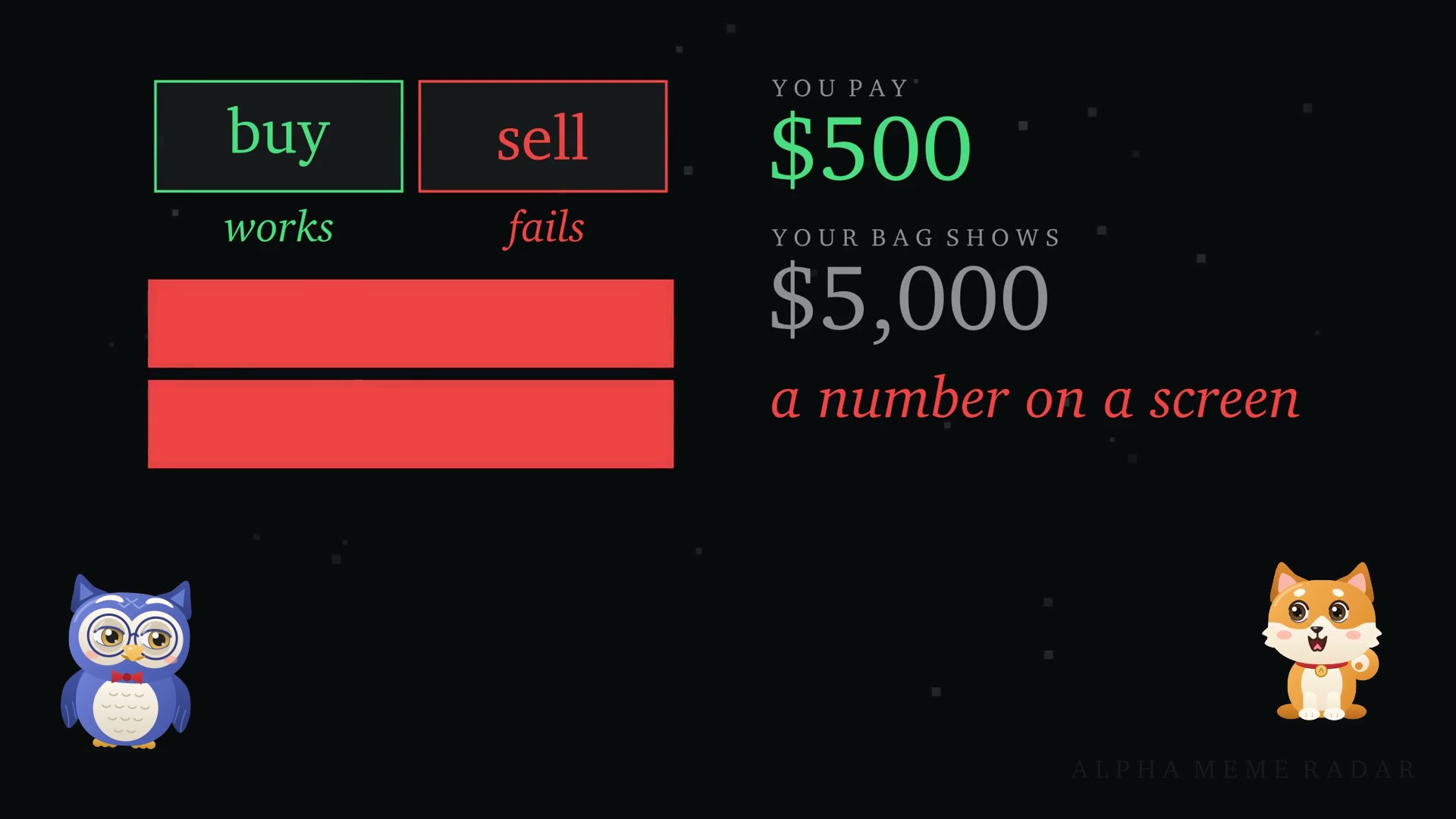
A honeypot is a token you can buy but can't sell. The buy button works. The sell button doesn't. The chart climbs, your bag looks bigger every minute, and none of it can be turned back into money. This guide explains how the trap works and what to check before you buy. It follows What Is a Rug Pull? and What Is a Sandwich Attack?.
For the full video explanation, check out this YouTube video:
What It Looks Like From the Inside
Say you find a coin where every candle is green, and you put in $500.
The price keeps climbing. Soon your bag shows $5,000: ten times your money, on paper.
You press sell, and the trade fails. You try again, and it fails again. Your $5,000 is just a number on a screen.
The green chart was the warning. A chart with no sellers can mean that nobody is able to sell.
Why It Is Possible
A token is a program. Every buy, sell and transfer runs through code that the token's creator wrote, and in a honeypot that code decides who is allowed to sell.
A normal token has no such rule. A honeypot adds one.
The Three Common Tricks
| Trick | What happens |
|---|---|
| A blacklist | The moment you buy, your wallet goes on a list, and wallets on that list can't sell. |
| A sell tax | Your sale goes through, but the token keeps a fee. Set that fee to 100%, and you get nothing back. |
| A switch | The coin trades normally at first. Then the owner flips a setting, and selling stops for everyone except the owner. |
There are others. Some tokens quietly change your balance, and some only allow sells above an amount nobody holds. They all end the same way: you can't get out.
The switch is the nastiest of the three, because the coin really is sellable for a while, until the owner flips the setting.
Where Your Money Goes
Your $500 did not vanish. It went into the pool, next to the ETH from every other buyer.
The only wallet that can still sell into that pool belongs to the scammer. They sell their tokens and take out the ETH that everyone else put in.
What to Check Before You Buy
1. Look at the trades. Open the trade list, not just the chart. Lots of buys and almost no sells is the warning sign. Real coins have sellers.
2. Use a honeypot checker. Paste the token's address into a honeypot checker. It tests a buy and then a sell against the real pool, and tells you if the sell fails or how much tax it takes. Use two checkers if you can.
3. See what the owner can still change. A check only tells you whether the token can be sold right now. If the owner can still raise the tax, block wallets or pause trading, a coin that passes today can become a trap tomorrow.
On Solana, look for freeze authority. A Solana token can keep a freeze authority, and whoever holds it can freeze the tokens in your wallet so they can't be moved or sold. Token explorers show whether it is still set. If the creator gave it up, it can never be used again.
A Famous One
In November 2021, a token named after the show Squid Game climbed past $2,850. Buyers reported that they could not sell it on its only market, and the founders said the token had "anti-dumping technology". Then the price fell to a fraction of a cent within minutes.
What This Guide Does Not Cover
A small test sell is a useful extra check, but it only proves that selling works at that moment and for that wallet. It does not rule out a switch.
A honeypot is not the only way to lose everything. A coin can pass every check here and still be rugged or dumped; see What Is a Rug Pull?.
The $500 example is an illustration, not market data.
Key Takeaways
- A honeypot is a token you can buy but can't sell.
- The usual tricks are a blacklist, a 100% sell tax, and a switch the owner flips later.
- Your money sits in the pool, and only the scammer can sell into the pool.
- Before you buy: look for real sells, run a honeypot checker, and see what the owner can still change. On Solana, check freeze authority.
- Before you ask how high a coin can go, ask if you can get out.
This article is for education only and is not financial advice.