
In Market Cap vs Liquidity we showed that the real money in a memecoin is the ETH in a coin's pool. That leaves one question every buyer should ask before buying: who can actually take that money out? This guide explains what a rug pull is, how the liquidity receipt (the LP token) makes it possible, and what "liquidity locked" and "liquidity burned" really protect you from.
For the full video explanation, check out this YouTube video:
The Coin We Are Using
We continue the example from the last guide:
- 1 billion tokens, launched with no ETH in the pool at a $100,000 market cap
- Buyers have put in $50,000 of ETH and taken out about a third of the supply, 333 million tokens
- The market cap now reads $225,000, and the buyers' tokens are worth $75,000 on paper
- The pool holds $50,000 of ETH and the other 667 million tokens
Who Can Take the ETH Out?
There are two ways ETH can leave a pool.
Sellers. Anyone who sells tokens into the pool takes some ETH out. That is normal trading.
The liquidity provider. When you put a liquidity position (LP) into a pool, (whether that's plain ETH, or one sided token liquidity) the pool gives you a receipt. On Uniswap v2 and similar exchanges it is an LP token; on Uniswap v3 it is a position NFT. Whoever holds that receipt can withdraw the liquidity: all of it, in one transaction.
The receipt goes to whoever adds the liquidity. In our example the dev added it, so the dev holds the receipt.
What Is a Rug Pull?
A rug pull is the dev using that receipt.
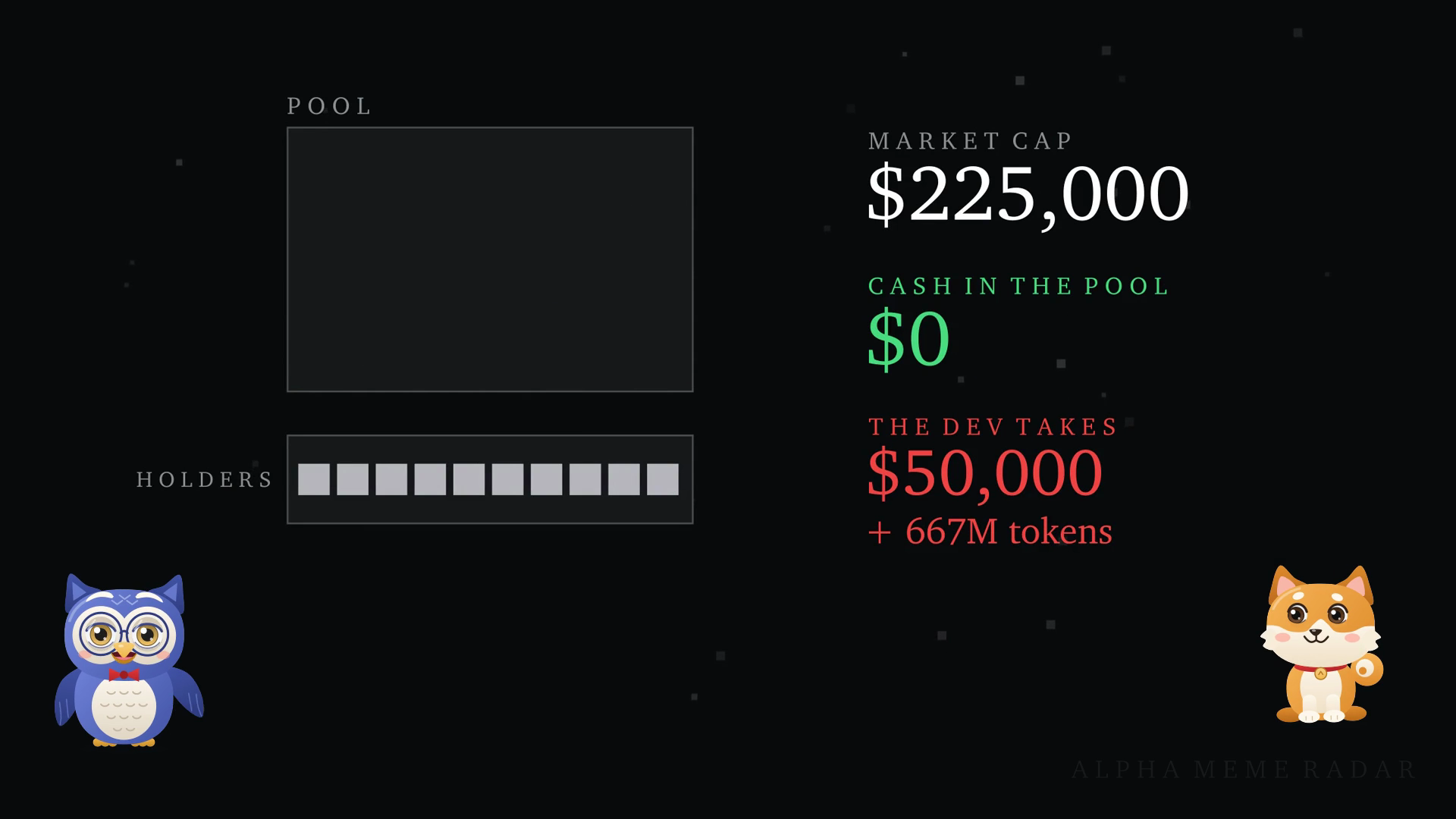
In our example the dev withdraws the whole position:
Before | After the pull | |
|---|---|---|
ETH in the pool | $50,000 | $0 |
Tokens in the pool | 667 million | 0 |
Buyers' tokens | 333 million | 333 million |
What buyers can sell for | up to $50,000 in total | $0 |
The dev walks away with the $50,000 of ETH and the 667 million tokens. The buyers still hold their 333 million tokens, but there is no pool left to sell them into. They paid $50,000 and can get back nothing.
Why does the Chart Can Still Look Fine?
You might expect the price to crash to zero on the chart. Often it does not. With no pool there are no trades, so the last traded price can simply stay on screen. A chart can go on showing a $225,000 market cap for a coin that nobody can sell.
This is the same lesson as the last guide, taken to its end: market cap is a price tag. Always look at the liquidity number next to it.
Locked Liquidity & Burned Liquidity
A buyer cannot know what a dev intends. A buyer can check where the receipt is. There are two good answers.
Locked. The LP token sits in a lock contract (a "liquidity locker") until a set date. Nobody, including the dev, can move it before then.
Burned. The LP token was sent to a dead address that nobody controls. That liquidity can never be withdrawn.
Two things to check:
- The date. A lock that ends next week is not much of a lock. When it ends, the dev can pull.
- The share. "Locked" should mean nearly all of the liquidity, not a small part of it.
The Second Way Out... The Dump
Locking the liquidity shuts one door. There is another.
Suppose the dev bought early, from a few wallets of their own. Of the 333 million tokens that "buyers" hold, 200 million really belong to the dev.
The dev sells all 200 million at once:
- The pool pays the dev about $34,600 of its $50,000
- The price drops about 41%
- About $15,400 of ETH is left for every other holder to sell into
The liquidity was locked the whole time. A lock stops the pull. It does not stop the dump.
How to Check Before You Buy?
- Is the liquidity locked or burned? Token scanners and chart sites may show this next to the pool. If it is locked, find the unlock date.
- How much of the supply sits in a few wallets? Look at the top holders. A handful of fresh wallets holding a large share of the supply is the setup for a dump.
- How much ETH is in the pool? That number, not the market cap, is what all holders together can take out.
What This Guide Does Not Cover
A liquidity lock and a clean holder list do not rule out every trick. Some tokens let the dev mint new supply, block selling (a honeypot), charge a sell tax, or change the contract later. Those are separate checks.
The numbers here are a worked example, not market data, and ignore swap fees.
Key Takeaways
- The ETH in the pool is the money. A rug pull is the dev taking it.
- The dev can do that when they hold the liquidity receipt (the LP token).
- Locked means the receipt cannot move until a date. Burned means it can never move.
- A lock stops the pull, not the dump. Check how much of the supply a few wallets hold.
- A chart can keep showing a market cap after the pool is empty.
This article is for education only and is not financial advice.