
A coin's page says its top ten holders own 35% of the supply. Is that bad? It depends on who is in the ten, because some of them are not people at all. Holder concentration is how much of a coin sits in a few wallets, and this guide shows how to check it properly. It follows What Is a Bundle?, What Is a Liquidity Pool? and What Is a Rug Pull?.
For the full video explanation, check out this YouTube video:
What a Holder List Shows
A holder list shows every wallet that holds the coin, biggest first, each with its share of the supply. "Top 10 hold 35%" means the ten biggest shares add up to 35%.
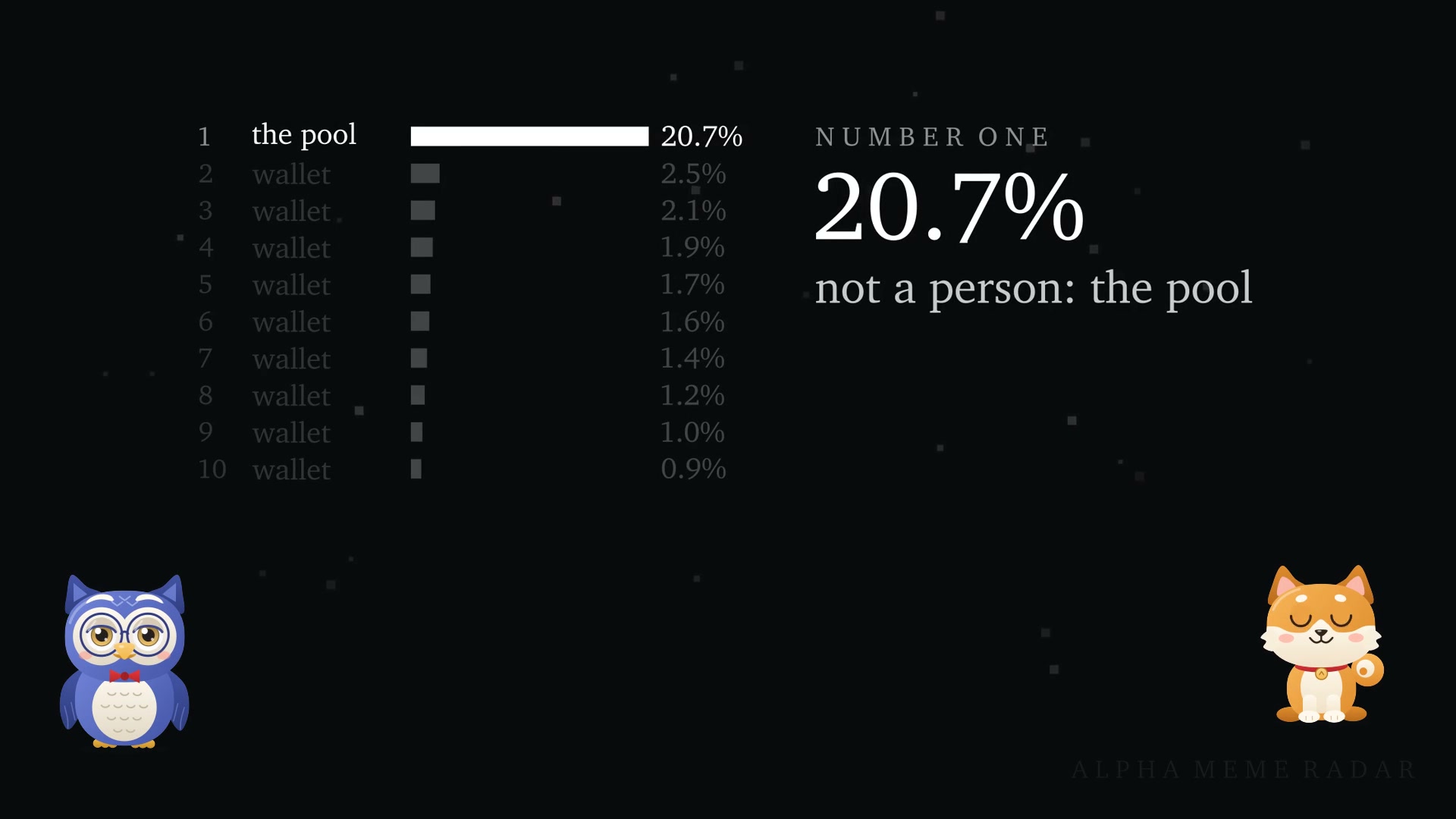
Here is an example list for a pump.fun coin that has just graduated:
| Rank | Holder | Share of the supply |
|---|---|---|
| 1 | The pool | 20.7% |
| 2 | Wallet | 2.5% |
| 3 | Wallet | 2.1% |
| 4 | Wallet | 1.9% |
| 5 | Wallet | 1.7% |
| 6 | Wallet | 1.6% |
| 7 | Wallet | 1.4% |
| 8 | Wallet | 1.2% |
| 9 | Wallet | 1.0% |
| 10 | Wallet | 0.9% |
| Top 10 | 35.0% |
Wallets to Leave Out First
The pool. Number one on that list is not a person. It is the liquidity pool, which holds the tokens that buyers trade against. A coin fresh from pump.fun starts its pool with about 206.9 million tokens, a fifth of the supply.
The bonding curve. Before a coin graduates, the bonding curve does the same job. It holds every token that nobody has bought yet, so early on it is by far the biggest holder.
Exchange wallets. One exchange address holds coins for many customers, so it is not one holder.
Burn addresses. On some chains, burned tokens sit in a dead wallet that still shows up on the list. On Solana a burn usually removes the tokens from the supply instead, so there is no row to leave out.
Take the pool out of the example, and the other nine wallets hold 14.3% between them. That is the number to judge.
How Much Is Too Much
Measure the share against the pool, because the pool is where those wallets would sell. The example pool holds 85 SOL and 206.9 million tokens. If holders sell into it:
| Who sells | Share of the supply | Price falls by |
|---|---|---|
| The biggest wallet alone | 2.5% | about 20% |
| One wallet with 5% | 5% | about 35% |
| One wallet with 10% | 10% | about 55% |
| All nine wallets | 14.3% | about 65% |
So even 14.3% is a lot next to a fresh pool. If all nine wallets sell, they take about 34.7 of the pool's 85 SOL with them.
Is there a fixed line? One risk scorer, Solana Tracker, marks a coin as danger when the top ten hold more than 15% of the supply, or when any single wallet holds more than 10%. Its page does not say whether the pool is counted in that top ten. Other tools show the shares and leave the judgment to you. That is one tool's line, not a law. What matters is how big the share is next to the pool: the same 14.3% is far less dangerous against a pool a hundred times deeper.
One Person, Many Wallets
A big holder can split into many small wallets, and then the top ten looks clean. That is why some tools group wallets that sent funds to each other and count each group as one holder. Bubblemaps draws those groups as clusters. Birdeye reports a second figure for the "top 10 unique users" after merging related accounts.
Linked wallets do not always send funds to each other directly. In one case documented by Bubblemaps, more than 150 wallets were funded from the same exchange in tight time windows. Each passed the money to a fresh wallet, and those wallets bought one coin in its first 30 minutes.
How This Differs From a Bundle Check
The bundle check asks who bought in the launch block. The holder list asks who holds the coin right now.
| Bundle check | Holder list | |
|---|---|---|
| Asks | Who bought in the launch block | Who holds the coin now |
| Misses | Wallets that were sent their tokens later | A bundle that already sold |
A bundle can sell and drop off the list. A wallet that was sent its tokens later never shows up in the launch block. Use both.
Before You Buy
1. Take out what is not a holder. The pool, the bonding curve, exchanges and burn addresses.
2. Add up what is left in the top ten. Then set it against the SOL in the pool.
3. Check whether those wallets are linked. Funded from the same place, or buying at the same time.
What This Guide Does Not Cover
Step-by-step use of any one holder tool, and how each site labels the pool or the curve on its holder tab. Team and vesting wallets on larger tokens, which are locked by contract rather than held by a trader. Whether a big holder is in profit and likely to sell. The price falls above leave out fees and assume the 85 SOL pool of a coin that has just graduated; the nine wallet shares are a made-up example, not market data.
Key Takeaways
- "Top 10 hold 35%" is the ten biggest shares added up, and some of them are not people.
- Leave out the pool, the bonding curve, exchange wallets and burn addresses before you judge the number.
- Measure what is left against the pool: nine wallets with 14.3% can take about 65% off the price of a coin with 85 SOL in its pool.
- One risk scorer flags a top ten above 15% or a single wallet above 10%. It is one tool's line, not a law.
- A holder list counts wallets, not people. Add up the ones that move together.
This article is for education only and is not financial advice.