BingX is delisting 20 memecoins from ChainSpot today, and withdrawals stay open until December 12. Sixteen of them are pump.fun tokens, and the exchange's own FAQ says it only delists assets that have lost their liquidity entirely.
BingX's FAQ says ChainSpot delists an on-chain asset only when it has completely lost its liquidity. Today the exchange is removing twenty tokens and calling them "high risk."
The one-minute version:
BingX Pulls 20 Tokens Off ChainSpot Today
BingX ChainSpot delists 20 trading pairs today at 11:00 UTC+8. The announcement, posted November 10, says the exchange wants to improve the trading experience and optimize spot market liquidity by removing pairs that carry high risk. It names each token along with its Solana contract address: Clude, GROKIUS, BP, ELON, COPPERINU, DONT, USOR, Buttcoin, snowball, BOXABL, KABUTO, NOTHING, WOJAK, LMAO!, PFP, Clash, BOT, MITCH, POLYFACTS and CLANKER.
ChainSpot lets users trade on-chain tokens straight from a spot account with USDT, skipping the decentralized exchange. BingX introduced it in 2025 as a route to newer tokens and says it evaluates listings on holder counts, total value locked and trading volume. Pulling these pairs closes a convenient on-ramp, and it also tests what BingX means by "high risk."
The Deadlines Holders Need to Know
Three dates matter, and they don't match. Trading ends today at 11:00 UTC+8, which is 03:00 UTC. Open orders that users haven't cancelled are cancelled automatically, a process BingX says can take one to three business days. Deposits are already permanently suspended and won't return.
Withdrawals stay open longer. They close on December 12 at 00:00 UTC+8, so the last full day to move tokens out is December 11. That gives holders about 30 days from today to send tokens to a personal wallet.
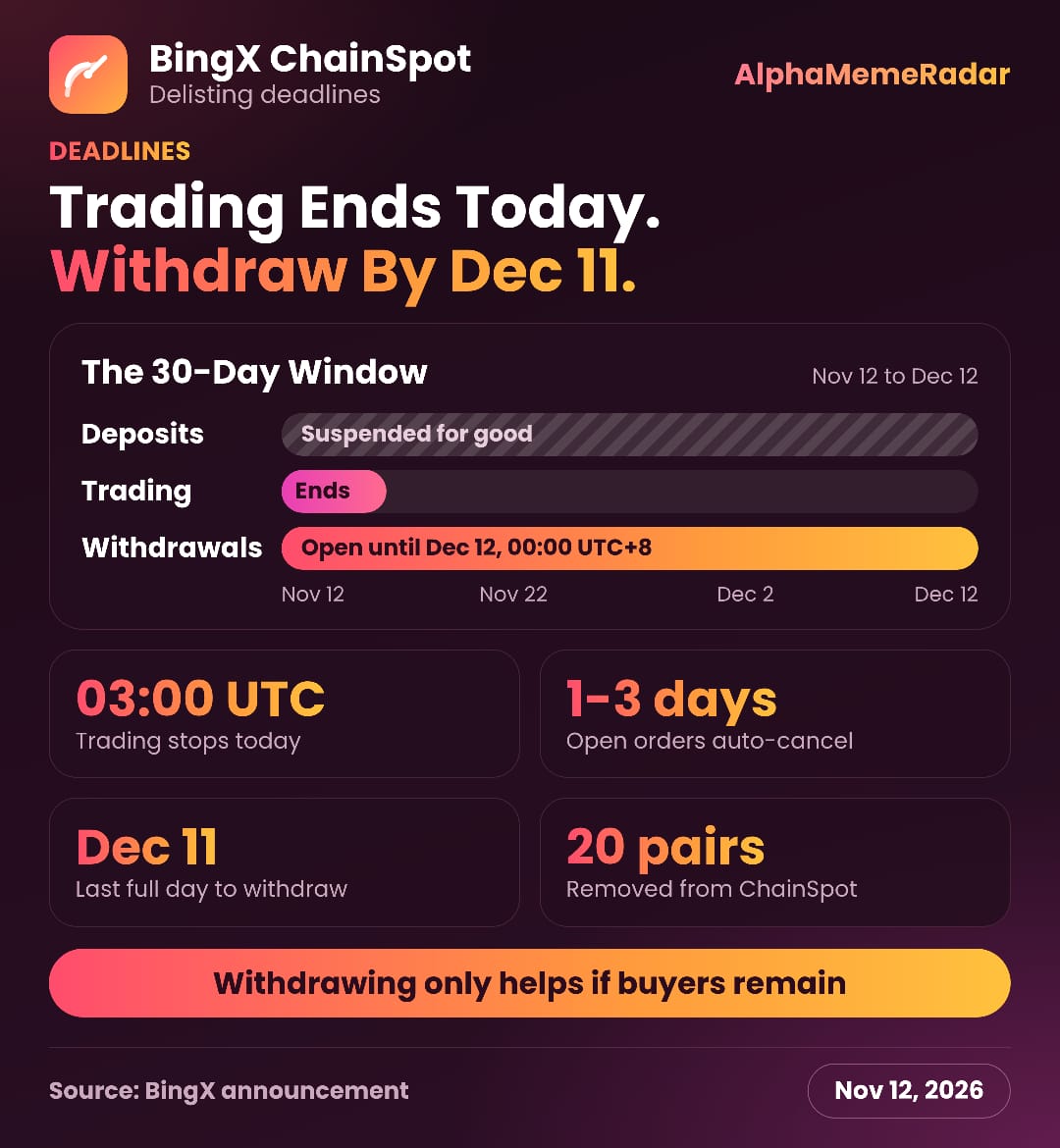 The gap between trading and withdrawing deserves attention. Once trading stops, nobody can sell on BingX. Moving tokens out only helps if someone can still buy them on-chain, and that depends on whether a liquidity pool still holds funds.
Where These Tokens Came From
The addresses reveal part of the story. Sixteen of the 20 end in "pump," the vanity suffix that marks tokens minted through pump.fun, the Solana launchpad. DONT ends in "bonk," which points to a Bonk-ecosystem launch, and BOT ends in "Bot." Two, COPPERINU and USOR, carry no recognizable suffix.
So the list is mostly launchpad memecoins. Tokens like these are cheap to create, often start on a bonding curve and sometimes keep supply concentrated in a few wallets.
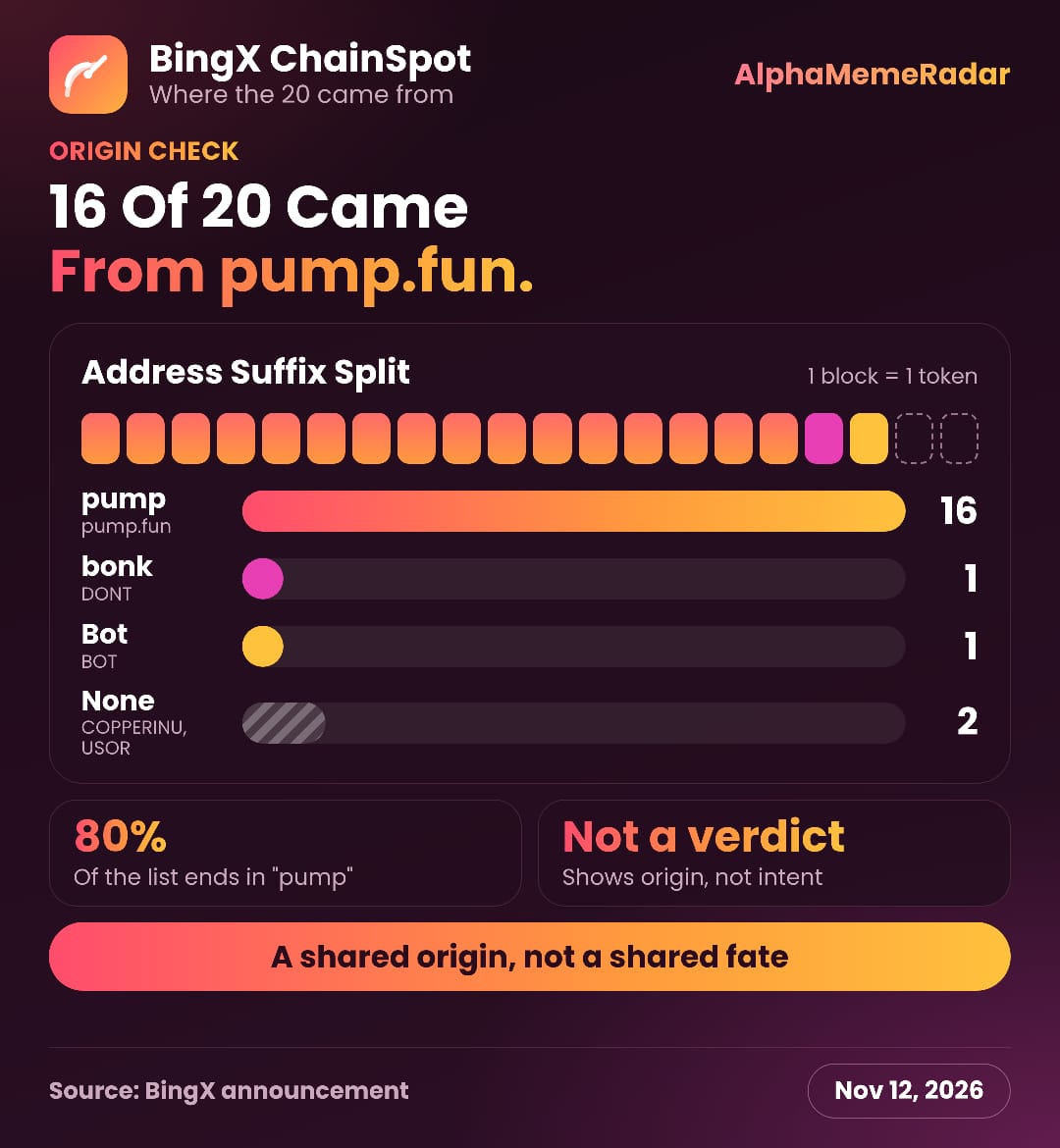 The suffix doesn't prove any of them is a scam, since pump.fun hosts everything from jokes with real communities to abandoned experiments. It does show a shared origin and a typical risk profile.
A list that sweeps up all of them raises a fair question: which of these tokens are actually dead? The answer varies a lot from address to address, and Buttcoin is the clearest example.
Buttcoin Shows How Blunt "High Risk" Can Be
Buttcoin was among the most visible tokens on the list, so its numbers make a useful test. Phantom's token page showed a $9 million market cap, $1.1 million in liquidity, 18,773 holders and $726,000 in 24-hour volume on July 21. On the morning of November 12, the same page shows a $6 million market cap, $721,000 in liquidity, 22,012 holders and $276,000 in volume.
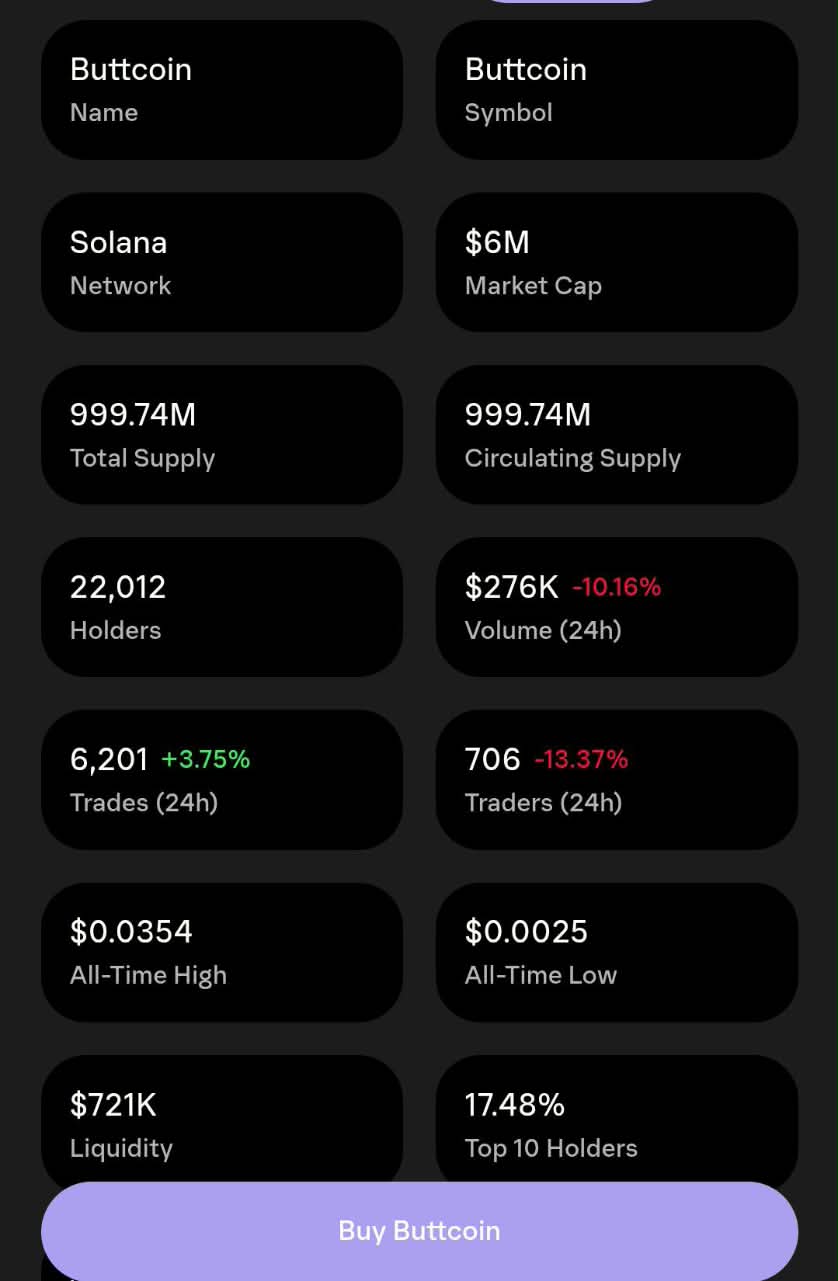 Side by side, those figures describe a cooling market, not a dead one. Volume fell 62%, yet trades rose from 5,874 to 6,201 and traders from 689 to 706. The average trade shrank from about $124 to about $45, which means people are still trading, just in smaller sizes. Holders grew by more than 3,000 wallets while the market cap dropped by about a third.
For a deeper look at why the two figures differ, see market cap vs liquidity on Alpha Meme Radar.
Liquidity also held its ground relative to market cap. It sat near 12% of market cap in July and sits near 12% now, so the pool shrank in step with the price. A pulled pool looks different, because liquidity collapses far faster than the price does. The top 10 wallets hold 17.48% of supply, up from 16.02%, which is moderate for a memecoin.
Buttcoin doesn't prove the other 19 are healthy. It does show the list isn't uniform. A token with $721,000 of liquidity and 22,012 holders sits in the same announcement as tokens that may have no market left at all.
The Gap Between "High Risk" and BingX's Own Rule
BingX's ChainSpot sets a different standard. It says ChainSpot doesn't delist assets as long as liquidity is provided, and that an on-chain asset is delisted only if it loses liquidity completely. In that case, the FAQ adds, the platform takes no special action and users can keep or withdraw the asset.
Today's announcement says nothing about a total loss of liquidity. It cites high risk and spot market liquidity. Buttcoin, with $721,000 sitting in its pools, doesn't match the FAQ's trigger. Either the policy has changed, BingX is applying a broader judgment, or the announcement used softer wording for a mixed group. The exchange hasn't said which.
That distinction decides what "high risk" means in practice. If the trigger is vanished liquidity, delisting changes little, since the tokens couldn't be sold anyway. If the trigger is a risk judgment on tokens that still trade, holders lose a convenient exit while the markets are still alive.
What Holders Should Do Before December 12
The steps are clear. Cancel open orders before the delisting time instead of waiting for the system to do it. Check each token's liquidity on a Solana explorer or DEX tracker before deciding anything. If a pool holds meaningful funds, as Buttcoin's does, withdrawing to a personal wallet before December 11 keeps the option to sell on-chain. If the pool is empty, the tokens may have no buyer, and withdrawing only moves a stranded balance.
Four checks turn "high risk" into numbers for any of the 20. Find the deployer wallet and see what else it launched. Measure how much supply the top holders control, leaving out pool and bonding-curve accounts. Compare the pool's liquidity now with its peak. Then look for a single large liquidity removal, the signature of a pulled pool and the clearest definition of a rug.
Alpha Meme Radar’s guide on what a rug pull is explains who can take money out of a memecoin’s pool and how to spot it on a chart.
Withdrawals carry network fees and need the right wallet address, so anyone with a large balance should test with a small amount first. None of this is financial advice, and anyone with a meaningful position should make the call for themselves.
The bigger lesson concerns convenience products. ChainSpot gave users one-click access to on-chain tokens without a DEX, and that convenience concentrated risk in assets whose liquidity can vanish. Today's delisting leaves holders with a 30-day window and one open question: whether anyone is left to buy.
Disclaimer: This article is for informational and educational purposes only and does not constitute financial, investment, legal or tax advice.