Mitosis is worth $2.55 million in total, and it traded more than that in a single day. That day was November 20, when Binance put MITO and five other tokens on its Monitoring Tag, the exchange’s warning label for coins that may no longer meet its listing standards.
The label isn’t a delisting. Even so, Binance’s own record this year shows that a tag leads to removal more often than not, and the six tokens have very different amounts of room to absorb that pressure.
What Binance Announced on November 20
Binance said that, based on recent reviews, it would add Lorenzo Protocol (BANK), Initia (INIT), Mitosis (MITO), Harmony (ONE), THENA (THE) and Zilliqa (ZIL) to the Monitoring Tag. The official announcement went out at 06:00 UTC and said the labels would appear shortly afterward. In the same notice, Binance removed the Seed Tag from Morpho (MORPHO) and Hyperliquid (HYPE).
 Nothing stops working for the six tokens. Binance said other services tied to them aren’t affected, so spot trading, deposits and withdrawals continue. What changes is the warning attached to each asset and the review schedule that comes with it.
How the Monitoring Tag Works
Binance describes Monitoring Tag tokens as markedly more volatile and riskier than other listings. They face regular reviews and can lose their place if they stop meeting listing criteria. The exchange says it will add or lift the tag as each review turns up new findings.
The checklist has ten items. It covers the team’s commitment, development activity, and trading volume and liquidity. It also looks at network and smart contract stability, public communication, responsiveness to due diligence requests, unjustified supply or tokenomics changes, signs of unethical conduct and contribution to the wider ecosystem.
Binance doesn’t say which items triggered the flag for which token. For BANK, ONE, THE and ZIL, the notice names no specific cause, and none of those four appeared in earlier tag announcements this year, so this is their first time on the list.
Ranking the Six by Liquidity
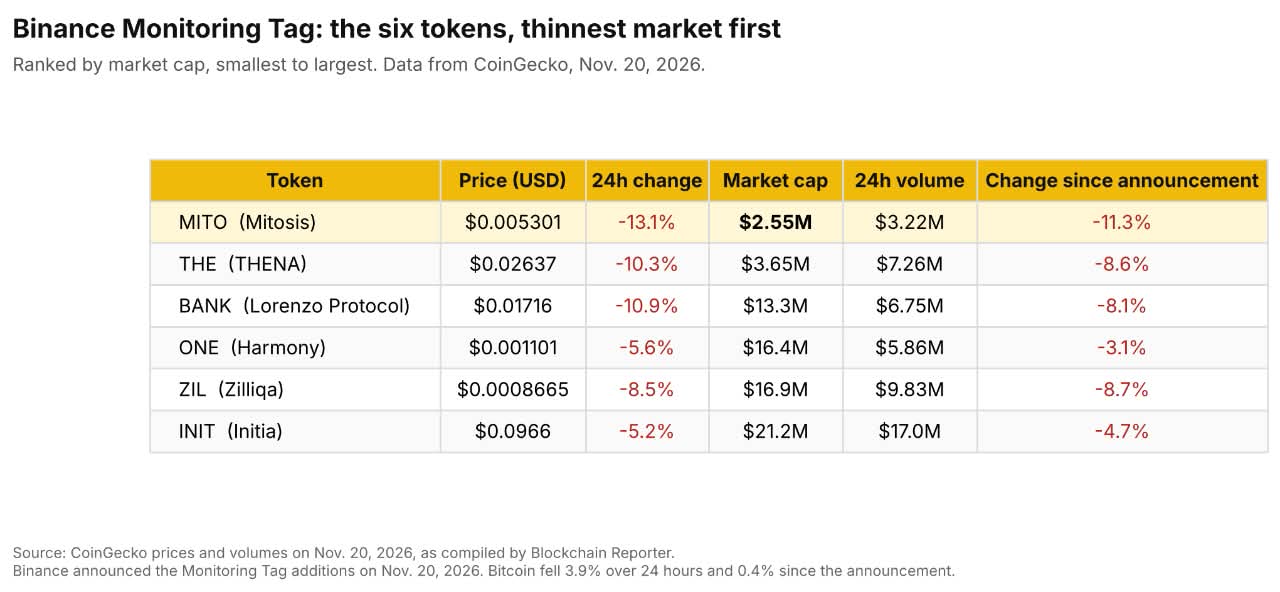
Binance lists trading volume and liquidity as a review criterion, so the thinnest markets deserve the closest look. Market value and daily volume give the clearest public read of depth, and the figures below come from CoinGecko as of 14:55 UTC on November 20.
Together, the six were worth about $74 million, according to Blockchain Reporter’s tally. Hyperliquid alone traded $1.19 billion in 24 hours, so the flagged group is tiny next to the tokens that lost their Seed Tag.
On those numbers, MITO is the thinnest. It has the smallest market value at $2.55 million and the lowest daily volume at $3.22 million, and its volume ran about 1.3 times its market cap. THE comes next, with volume of $7.26 million, roughly double its $3.65 million market value. Both tokens trade heavily relative to their size, which often means a small group of traders can move the price. INIT sits at the other end, with the deepest market of the six at $21.2 million and the lowest volume-to-value ratio among the flagged tokens that fell.
The tokens dropped fast. The six fell 8.9% on average over 24 hours, against 3.9% for Bitcoin. Measured from the 06:00 UTC announcement, they averaged a 7.4% loss while Bitcoin slipped 0.4%. With books this thin, a single seller can swing the price, so the slide is consistent with the tag adding pressure without proving it caused the drop.
Delisting Odds: What the 2026 Record Shows
Blockchain Reporter counted Binance’s own notices. Binance put 60 tokens under the Monitoring Tag in 11 announcements between January 2 and October 9, and 35 have since been removed from spot trading. That is a 58% conversion rate, with a median gap of 48 days.
Apply that base rate to six tokens and three or four removals would be the expected result. A 48-day median from November 20 lands around January 7, 2027. These are rough projections from a base rate, not forecasts for any single token.
The spread is wide, which matters for timing. TRU went from tag to removal in 14 days, which would mean early December for this group. QUICK took 181 days, which would stretch into May 2027. Removals also come in clusters: Binance pulled eight tokens from spot on April 1, and six of them had been tagged within the previous three weeks.
The tag can also end in a pardon. FLOW was tagged on January 2 and cleared on March 6 without a delisting, and 25 of the 60 tokens tagged this year haven’t been removed. A tag opens a review, and that review can close in either direction. The 58% figure measures how often the label came before a removal, not how often it caused one.
What’s Behind Each Flag
Two of the six carry a dated public record that maps onto the checklist. Initia’s layer-1 network halted on October 25 after a day-zero mint exploit drained $2.7 million, and network and smart contract stability are core items on Binance’s list.
Mitosis lost its derivatives market before it picked up the Monitoring Tag. Binance delisted the MITOUSDT perpetual contract on October 23, about three weeks before the tag arrived. That fits the liquidity criterion, and it makes MITO the token with both the thinnest market and the clearest earlier warning sign.
What Holders Should Watch Next
First, watch the next Binance announcement, because the exchange publishes tag removals and delisting notices separately. Past tag batches have arrived every one to six weeks, in groups of two to nine tokens.
Second, watch trading volume. For MITO and THE, a market value this small leaves little room if volume dries up, and Binance can point to liquidity as a criterion. For INIT, the question is whether the network keeps running cleanly after its October halt.
Third, watch for a lift. A tag that gets removed, like FLOW’s in March, shows a project can clear the review. Holders of any of the six should treat the label as a countdown with no fixed end date, and size their risk to the thinnest books first. This article is not investment advice.
The six tokens on Binance’s Monitoring Tag show why a small market value and heavy daily volume can leave holders with little room to exit. Alpha Meme Radar’s explainer on market cap vs liquidity shows how to read the two numbers together before you buy or sell a thin token.