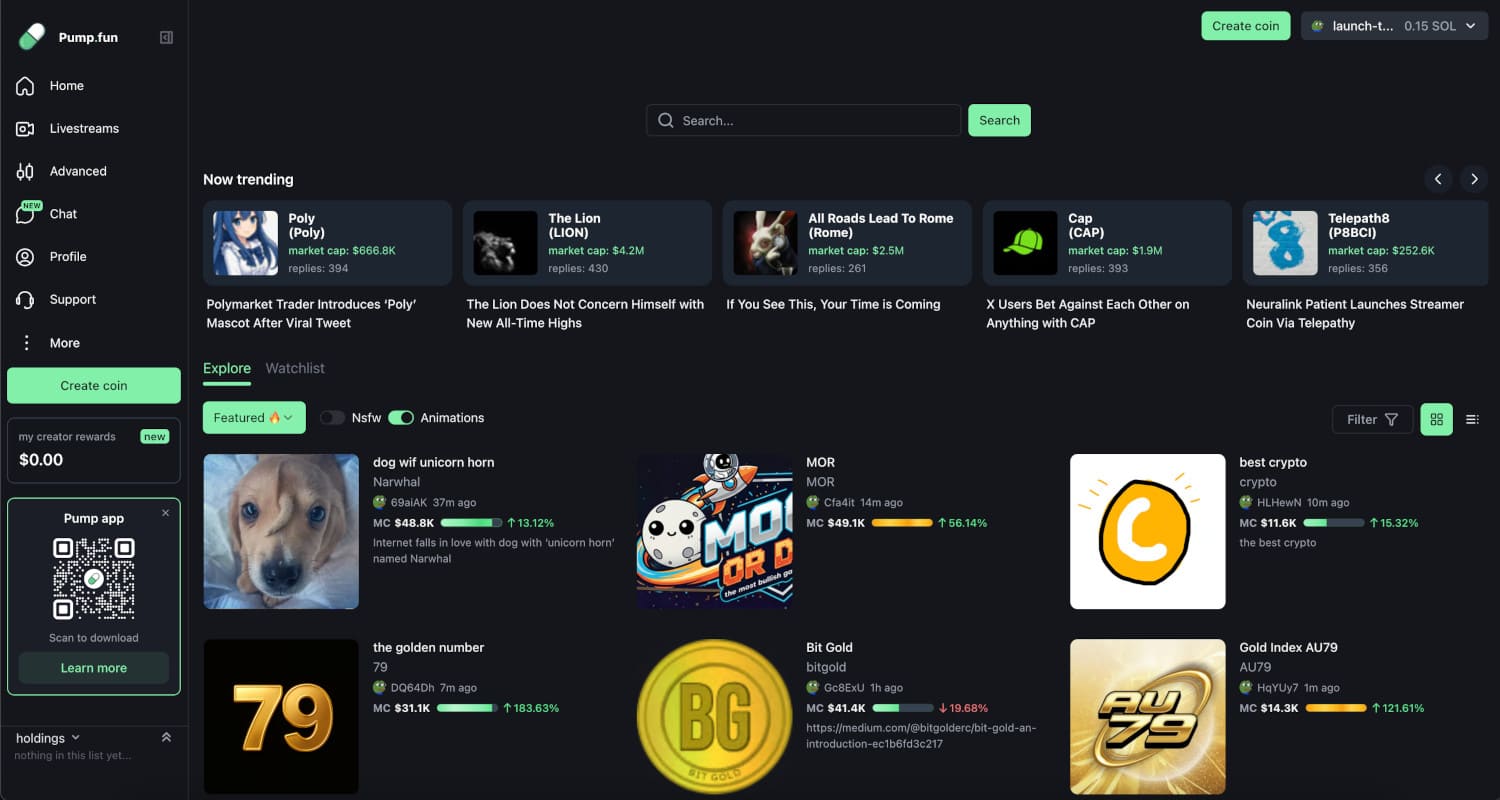
To make a coin on Pump.fun, sign in at pump.fun, click Create in the sidebar, enter a coin name and ticker, upload an image, and create the coin. Pump.fun charges no platform fee to create a coin; you pay only Solana network costs. The coin has a fixed supply of 1 billion tokens and trades on a bonding curve straight away, with a 1.25% fee on each trade, of which 0.30% goes to you as the creator.
This guide covers every field on the create form, what the first buy does, the fees, and what happens when a coin graduates to PumpSwap. For a live walkthrough, watch the video:
Pump.fun at a Glance
Setting | What Pump.fun does |
|---|---|
Where | pump.fun/create, or the create button on your profile in the Pump.fun mobile app |
Chain | Solana |
Cost to create | No platform fee. You pay the Solana network fee and the small deposit for the token's accounts. The help center suggests keeping 0.04 SOL if you make a first buy. |
Total supply | 1,000,000,000 tokens. No more can be minted. (Mayhem mode mints an extra 1 billion for its trading agent.) |
Fee on the bonding curve | 1.25% per trade: 0.30% to the creator and 0.95% to Pump.fun |
Platform fee | Since October 17, 2026, trades placed in the Pump.fun web or mobile app add 0.45% (0.40% with a referral code), including your own first buy |
Graduation | Automatic, to PumpSwap. The LP tokens are burnt. A 0.015 SOL migration fee is taken from the curve. |
Creator fee after graduation | 0.30% while the market cap is under 420 SOL, 0.95% from 420 to 1,470 SOL, then stepping down as the market cap grows, to 0.05% above 98,240 SOL |
Figures are from Pump.fun's fees page (last updated October 17, 2026), its create guide and its help center, checked on November 15, 2026.
What You Need Before You Start
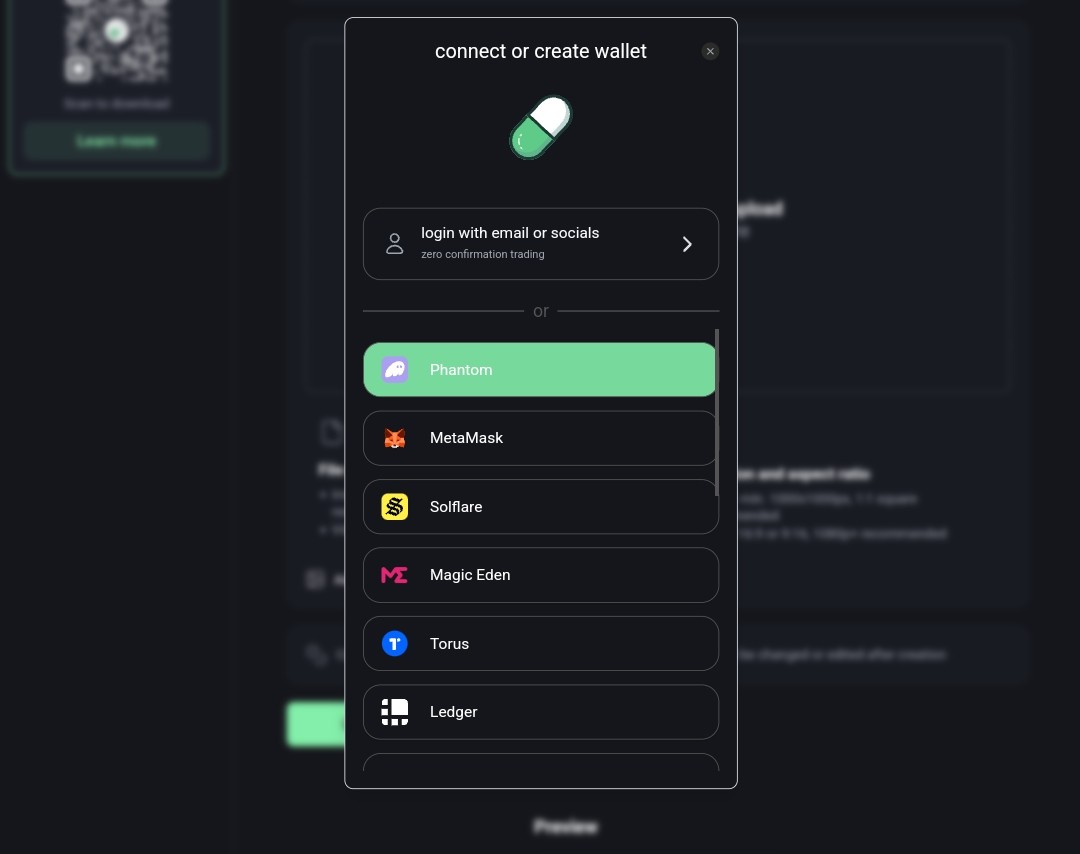
- A way to sign in. Today you can connect a Solana wallet such as Phantom, Solflare or Backpack, or sign in with email. Pump.fun has announced that external wallet sign-in on the website ends on November 30, 2026; after that the site signs in with email, Google, Apple or GitHub and gives you a Pump wallet.
- A little SOL. Creating is free, but a first buy and the network costs are paid in SOL.
- A square image of at least 1000 x 1000 pixels (up to 15 MB), or a short video.
- Your final name and ticker. The form warns that coin details cannot be changed once the coin is created.
- To be allowed to use it. Pump.fun's terms require you to be 18 or older and prohibit use from the United Kingdom and from sanctioned countries and regions.
How to Make a Coin on Pump.fun
The screenshots below were taken in late 2025. Pump.fun has renamed a few buttons since; the steps use the current labels.
Step 1: Open pump.fun and sign in
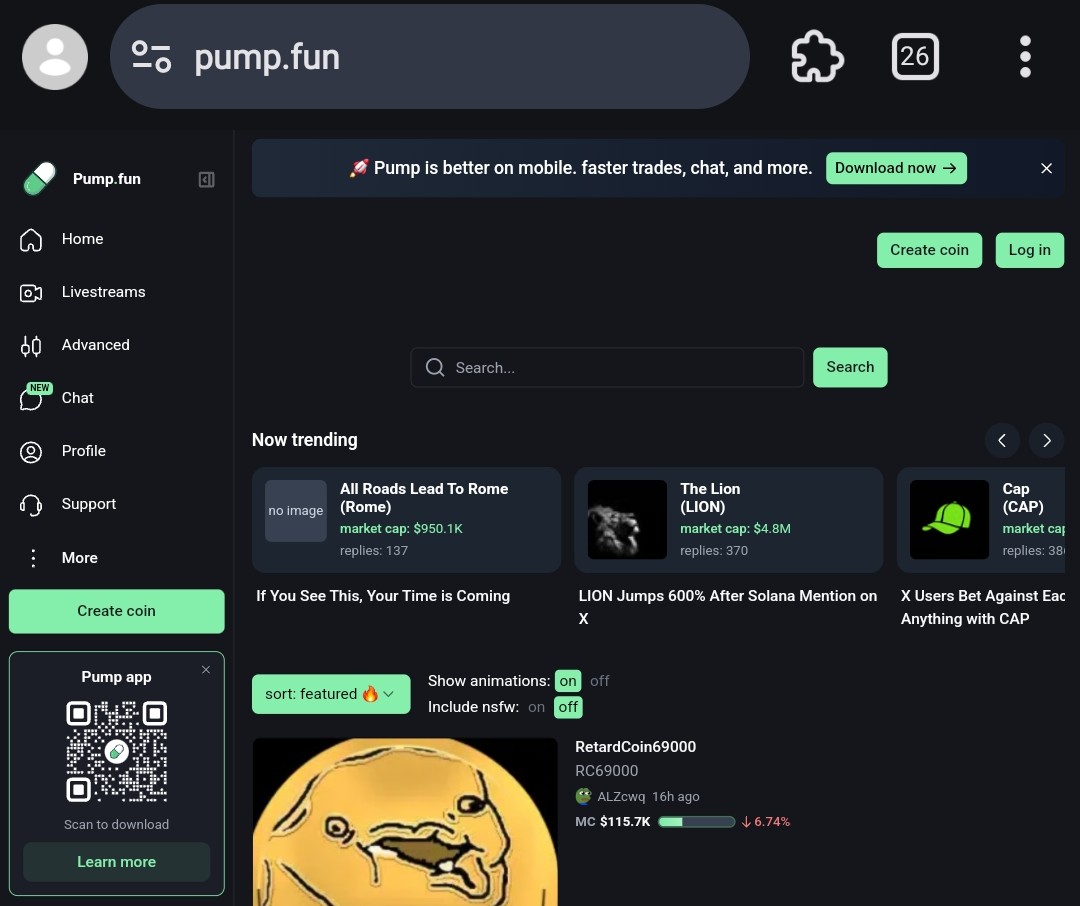
Go to pump.fun and click Sign in.
Go to pump.fun and click Sign in. On your first visit you are asked to accept the terms and confirm that you are over 18.
Step 2: Click Create
Choose Create in the sidebar to open the Create new coin form.
Click Create in the sidebar. This opens the Create new coin form at pump.fun/create. In the mobile app, the create button is on your profile.
Step 3: Fill in the coin details
Enter the coin name and ticker, then the optional description and social links.
Under Coin details, enter:
- Coin name, up to 32 characters.
- Ticker. Pump.fun's guide suggests 3 to 6 capital letters.
- Description, optional.
- Social links, optional: website, Telegram and X.
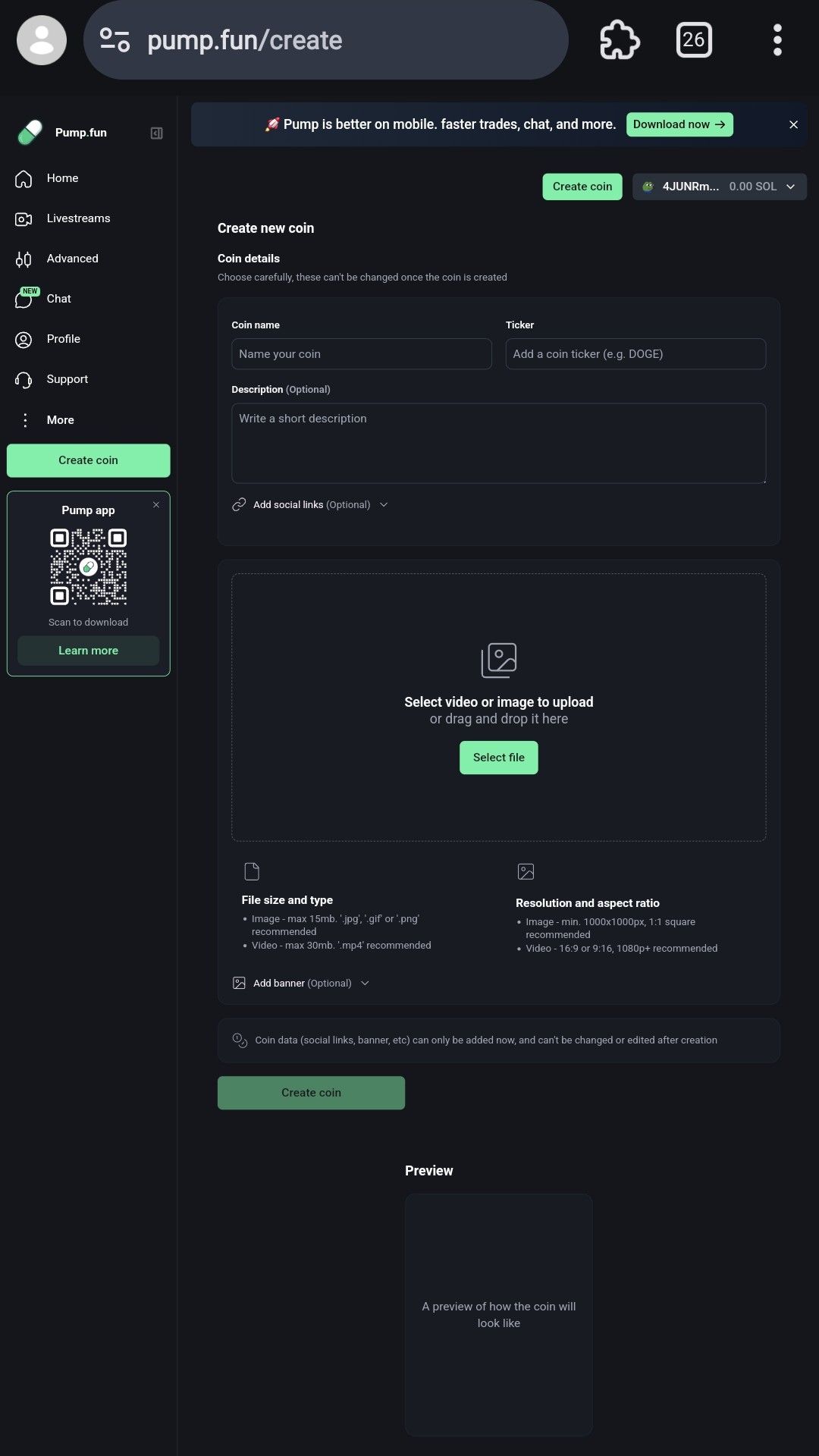
Social links and the banner can only be added now. They cannot be edited after the coin is created.
Step 4: Choose the pair, the rewards and Mayhem mode
Pick the pool liquidity pair, who receives creator rewards, and leave Mayhem mode off unless you want it.
Three settings sit below the coin details:
- Pool liquidity pair: SOL, USDC or Custom. Most memecoins use SOL.
- Send creator rewards to: Creator or Holders. With Creator, the creator fee comes to you. With Holders, it is distributed to the coin's holders instead, and the coin can never switch back.
- Mayhem mode: an optional toggle. When on, an AI trading agent trades the coin on the curve for its first 24 hours and 1 billion extra tokens are minted for it. It can only be set at creation.
Step 5: Upload the image and create the coin
Add the image or video and an optional banner, check the preview, and create the coin.
Upload the coin image or video and, if you want one, a banner (1500 x 500 pixels). Check the preview panel, then press the create button at the bottom of the form.
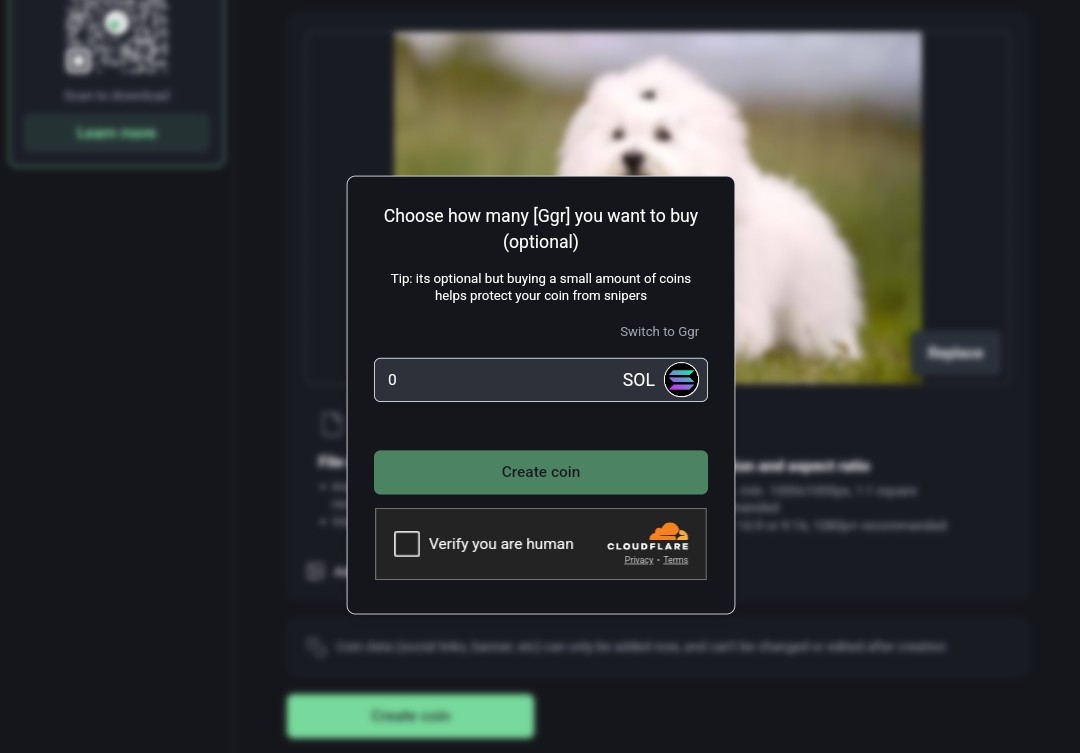
Step 6: Decide on a first buy
Optionally buy some of your own coin as you create it.
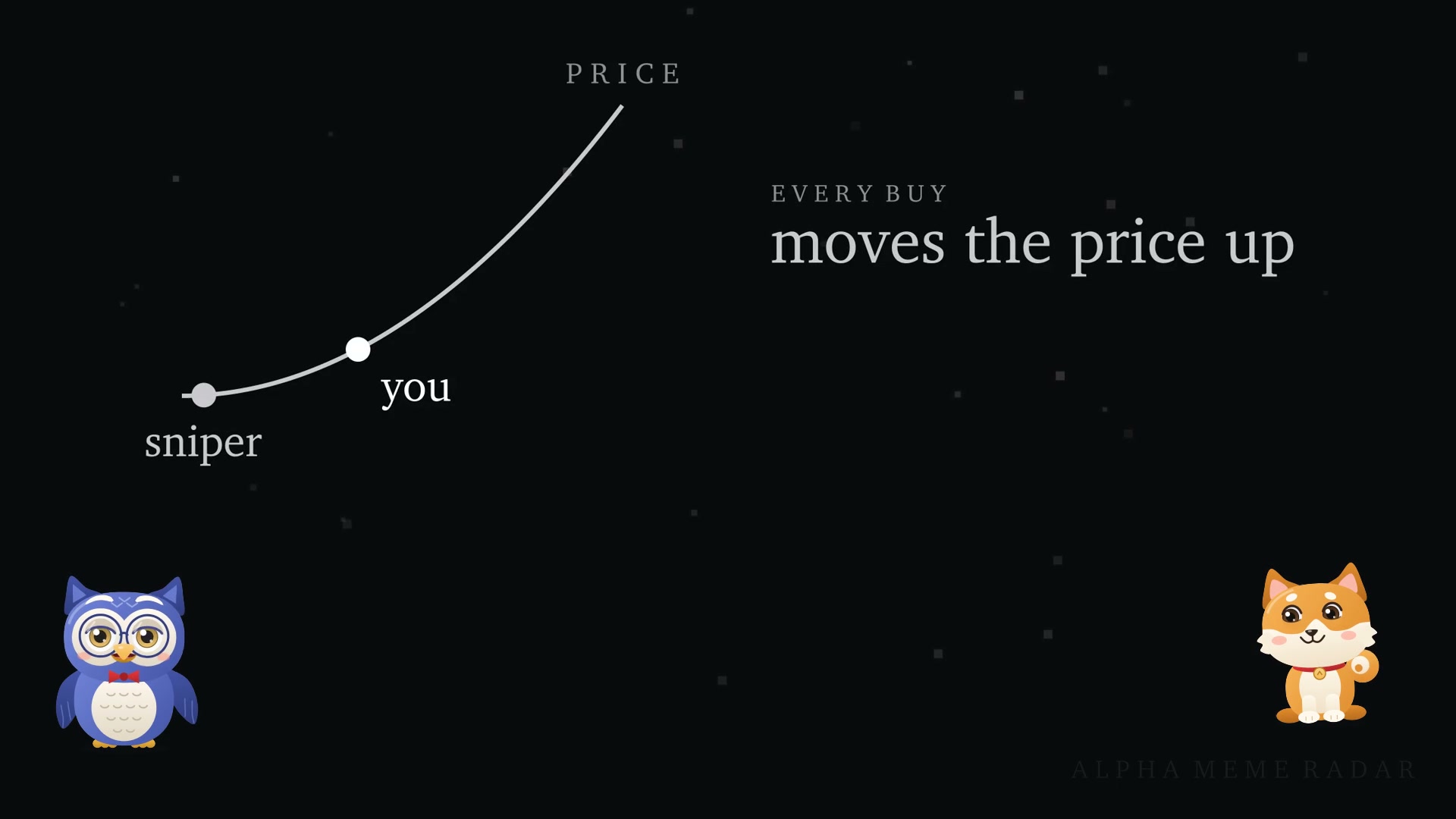
When you create the coin you can buy some of it in the same step. This first buy is optional, but it does two things. It puts the coin on-chain: Pump.fun's help center says a coin created without a buy stays "offchain" and out of public view until you or anyone else with the link makes the first purchase. It also gets you tokens before any sniper bot can buy.
The first buy pays the same fees as any other trade. Buyers can see how much of the supply the creator holds, and a large creator holding is a common reason for traders to stay away.
What Happens After You Create the Coin
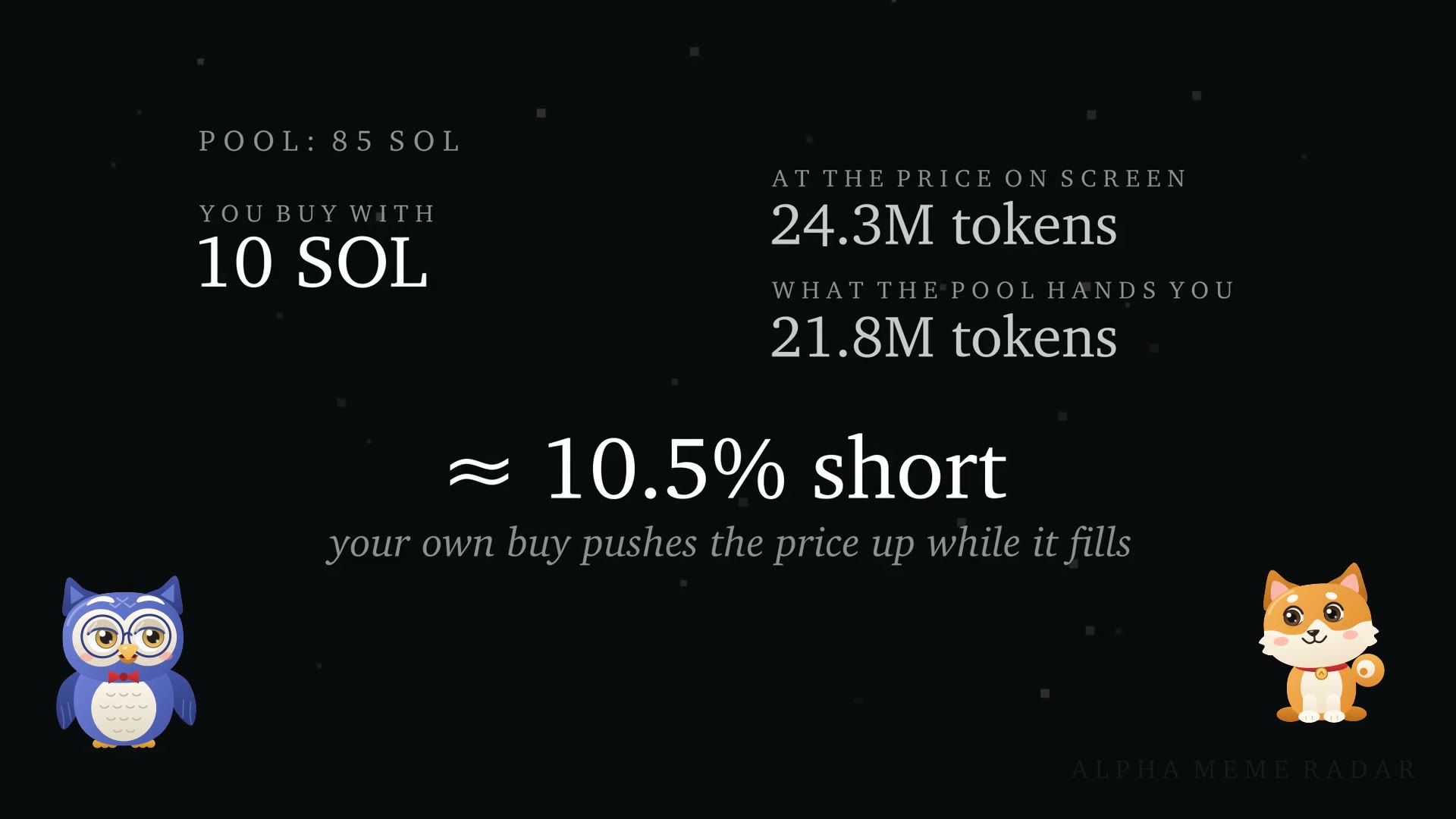
- The bonding curve. The coin trades against a bonding curve from the first buy. 793.1 million of the 1 billion tokens are sold on the curve, and the price rises as they sell. See what slippage is for why bigger buys get a worse price.
- Graduation to PumpSwap. When the curve sells out, the coin moves to PumpSwap, Pump.fun's own exchange, automatically. Pump.fun does not publish the threshold as a single figure; the on-chain settings work out to about 85 SOL raised for a SOL-paired coin. The LP tokens are burnt, so nobody can withdraw the pool. That removes one kind of rug pull, though holders can still sell.
- Creator fees. You earn 0.30% of every trade on the curve. After graduation the rate depends on the coin's market cap, as shown in the table above. You can also share creator rewards with other wallets or a charity from the coin page.
- Most coins do not graduate. Thousands of coins are created every day and only a small share reach PumpSwap. A coin's market cap is not the money in its pool.
Frequently Asked Questions
How much does it cost to make a coin on Pump.fun?
Pump.fun charges no platform fee to create a coin. You pay the Solana network fee and the deposit for the token's accounts. Its help center suggests about 0.04 SOL if you also make a first buy.
Do I need to know how to code?
No. You fill in a form and Pump.fun deploys the token. The supply is fixed at 1 billion and the token's metadata cannot be changed afterwards.
Can I create a Pump.fun coin on my phone?
Yes. Pump.fun has a mobile app, and its help center says you create a coin from the create button on your profile. The fields and costs are the same as on the website.
How do creators make money on Pump.fun?
Through the creator fee: 0.30% of each trade while the coin is on the bonding curve, and between 0.05% and 0.95% after graduation depending on market cap. There is no guarantee a coin will trade at all.
How do you make a successful Pump.fun coin?
No setting on the form makes a coin succeed. Coins that hold attention usually have a clear idea, a creator who stays active, and a small creator holding. Anyone who promises a result is guessing.
Where does a Pump.fun coin trade after it graduates?
On PumpSwap. Coins used to migrate to Raydium, but Pump.fun replaced that path with its own exchange in 2025.
Can I change the name, ticker or image later?
No. Pump.fun's create guide says the name, symbol and image are part of the token metadata and are immutable.
Related Guides
- How to launch a memecoin on Raydium LaunchLab
- How to launch a memecoin on Bonk.fun
- How to launch a memecoin on Bags
- How to launch a token on Jupiter Studio
- How to launch a memecoin on Four.meme (BNB Chain)
- What is a sandwich attack?
This guide is for education and is not financial advice. Launching or buying a memecoin can lose you the full amount you put in.